Pearson Edexcel · GCSE · English Language
Course version: 1EN0 · Version from Mar 2026
Non-fiction and Transactional Writing - 2.1 Reading: 2.1.2 critical…
Full specification wording
Component 2: Non-fiction and Transactional Writing - 2.1 Reading: 2.1.2 critical reading and comprehension: identify and interpret themes, ideas and information in a range of literature and other high-quality writing; read in different ways for different purposes, and compare and evaluate the usefulness, relevance and presentation of content for these purposes; draw inferences and justify these with evidence; support a point of view by referring to evidence within the text; identify bias and misuse of evidence, including distinguishing between statements that are supported by evidence and those that are not; reflect critically and evaluatively on text, use the context of the text and draw on knowledge and skills gained from wider reading; recognise the possibility of different responses to a text
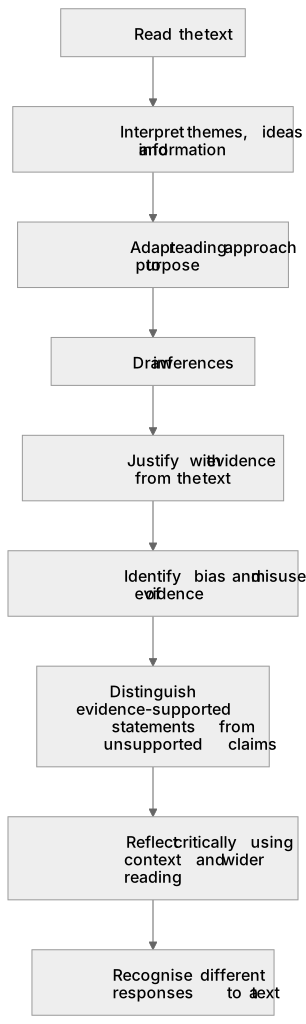
Critical reading goes beyond understanding: you interpret themes, ideas and information, adapt how you read to suit the purpose, and judge how useful, relevant and well presented content is.
Checked against the Pearson Edexcel 1EN0 specification (opens in a new tab) on .
- Point 2 of 5
- 4 key terms
Study notes
From the checked teaching notes for this specification point.
The idea
Critical reading goes beyond understanding: you interpret themes, ideas and information, adapt how you read to suit the purpose, and judge how useful, relevant and well presented content is. You draw inferences and justify them with evidence, and you support your own viewpoint by pointing to the text. You also spot bias and misuse of evidence, separating claims backed by evidence from unsupported assertions. For example, a charity leaflet may use one emotive case study but no statistics, so its emotional impact is strong while its evidential basis is thin. Finally, you reflect evaluatively, using context and wider reading, and accept that different readers may respond differently, explaining why.
What earns the marks
- Interprets themes and ideas, offering a plausible reading supported by carefully chosen evidence from the text.
- Adapts reading approach to purpose, for example skimming for gist, scanning for data, or close reading for tone.
- Compares and evaluates texts for usefulness, relevance and presentation, judging which best suits a stated purpose.
- Draws inferences and justifies them with quotation or close reference, explaining what the evidence suggests.
- Identifies bias and distinguishes statements supported by evidence from unsupported assertion or opinion.
- Reflects critically using context and wider reading, and recognises that other readers may respond differently.
- Identifies and interprets information as well as themes and ideas, for example extracting key facts from a report or data from a table.
- Applies critical reading to a range of literature and other high-quality writing, including fiction, non-fiction, journalism and literary non-fiction, adapting interpretation to different text types.
Common mistakes and how to put them right
Treating every statement in a text as fact.
Put it right: Ask what evidence supports each claim and label opinion as opinion.
Offering a personal reaction with no textual evidence.
Put it right: Anchor every judgement to a quotation or specific detail.
Assuming there is one correct reading.
Put it right: Present your interpretation as one valid response and acknowledge alternatives.
Ignoring information in favour of themes and ideas.
Put it right: Ensure you can identify and interpret explicit information as well as implied meanings.
Limiting analysis to one text type.
Put it right: Practise critical reading across literature and other high-quality writing, including fiction and non-fiction.
Exam tips
- Use short embedded quotations and explain what each one suggests, rather than listing quotes.
- When comparing texts, organise by idea or judgement, not by describing each text separately in turn.
- Signal evaluation explicitly with words such as 'useful', 'limited', 'biased' or 'well evidenced', then justify the label.
- When reading a range of texts, note the genre and form first, as this shapes how information and ideas are presented.
Try the lesson
The start of the Component 2: Non-fiction and Transactional Writing - 2.1 Reading: 2.1.2 critical reading and comprehension: identify and interpret themes, ideas and information in a range of literature and other high-quality writing; read in different ways for different purposes, and compare and evaluate the usefulness, relevance and presentation of content for these purposes; draw inferences and justify these with evidence; support a point of view by referring to evidence within the text; identify bias and misuse of evidence, including distinguishing between statements that are supported by evidence and those that are not; reflect critically and evaluatively on text, use the context of the text and draw on knowledge and skills gained from wider reading; recognise the possibility of different responses to a text lesson, made from checked teaching notes for this specification point.
Have a go first
A travel article says: 'The beach was empty, the sea was calm and the sun was warm.' Which idea about the beach does the writer present?
Listen
Critical reading goes beyond understanding: you interpret themes, ideas and information, adapt how you read to suit the purpose, and judge how useful, relevant and well presented content is. You draw inferences and justify them with evidence, and you support your own viewpoint by pointing to the text. You also spot bias and misuse of evidence, separating claims backed by evidence from unsupported assertions. For example, a charity leaflet may use one emotive case study but no statistics, so its emotional impact is strong while its evidential basis is thin. Finally, you reflect evaluatively, using context and wider reading, and accept that different readers may respond differently, explaining why. A strong answer earns marks for these points. Interprets themes and ideas, offering a plausible reading supported by carefully chosen evidence from the text. Adapts reading approach to purpose, for example skimming for gist, scanning for data, or close reading for tone. Compares and evaluates texts for usefulness, relevance and presentation, judging which best suits a stated purpose. Draws inferences and justifies them with quotation or close reference, explaining what the evidence suggests. A common slip: Treating every statement in a text as fact. Instead, ask what evidence supports each claim and label opinion as opinion. Exam tip: Use short embedded quotations and explain what each one suggests, rather than listing quotes.
See it
Key words
Say what each word means before you turn the card.
Interpretation of themes, ideas and information
Try answering aloud or in your head before turning the card.
Inference and evidence
Try answering aloud or in your head before turning the card.
Bias and misuse of evidence
Try answering aloud or in your head before turning the card.
Critical evaluation and different responses
Try answering aloud or in your head before turning the card.
See every definition
- Interpretation of themes, ideas and information
- Offering a plausible reading of themes and ideas, and identifying and interpreting information, supported by carefully chosen evidence from the text.
- Inference and evidence
- Drawing inferences and justifying them with quotation or close reference, explaining what the evidence suggests.
- Bias and misuse of evidence
- Identifying bias and distinguishing between statements that are supported by evidence and those that are not.
- Critical evaluation and different responses
- Reflecting critically and evaluatively on text using context and wider reading, and recognising the possibility of different responses to a text.
Label the diagram
Some boxes have lost their names. Pick the right name for each number.
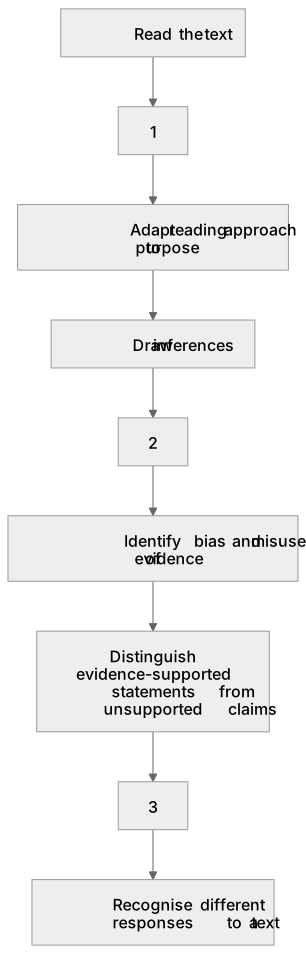
1Box 1
2Box 2
3Box 3
There is more to this lesson
The full lesson goes on to check your understanding and help you earn the marks. Create a free account to carry on, with your progress saved.
A week of Premium from your first lesson · Then the free plan continues · No card, no charge
Test your understanding of Component 2: Non-fiction and Transactional Writing - 2.1 Reading: 2.1.2 critical reading and comprehension: identify and interpret themes, ideas and information in a range of literature and other high-quality writing; read in different ways for different purposes, and compare and evaluate the usefulness, relevance and presentation of content for these purposes; draw inferences and justify these with evidence; support a point of view by referring to evidence within the text; identify bias and misuse of evidence, including distinguishing between statements that are supported by evidence and those that are not; reflect critically and evaluatively on text, use the context of the text and draw on knowledge and skills gained from wider reading; recognise the possibility of different responses to a text
Active recall beats re-reading. Take an instant quiz now to test what you’ve learned and lock it into long-term memory.
A week of Premium from your first lesson · Then the free plan continues · No card, no charge